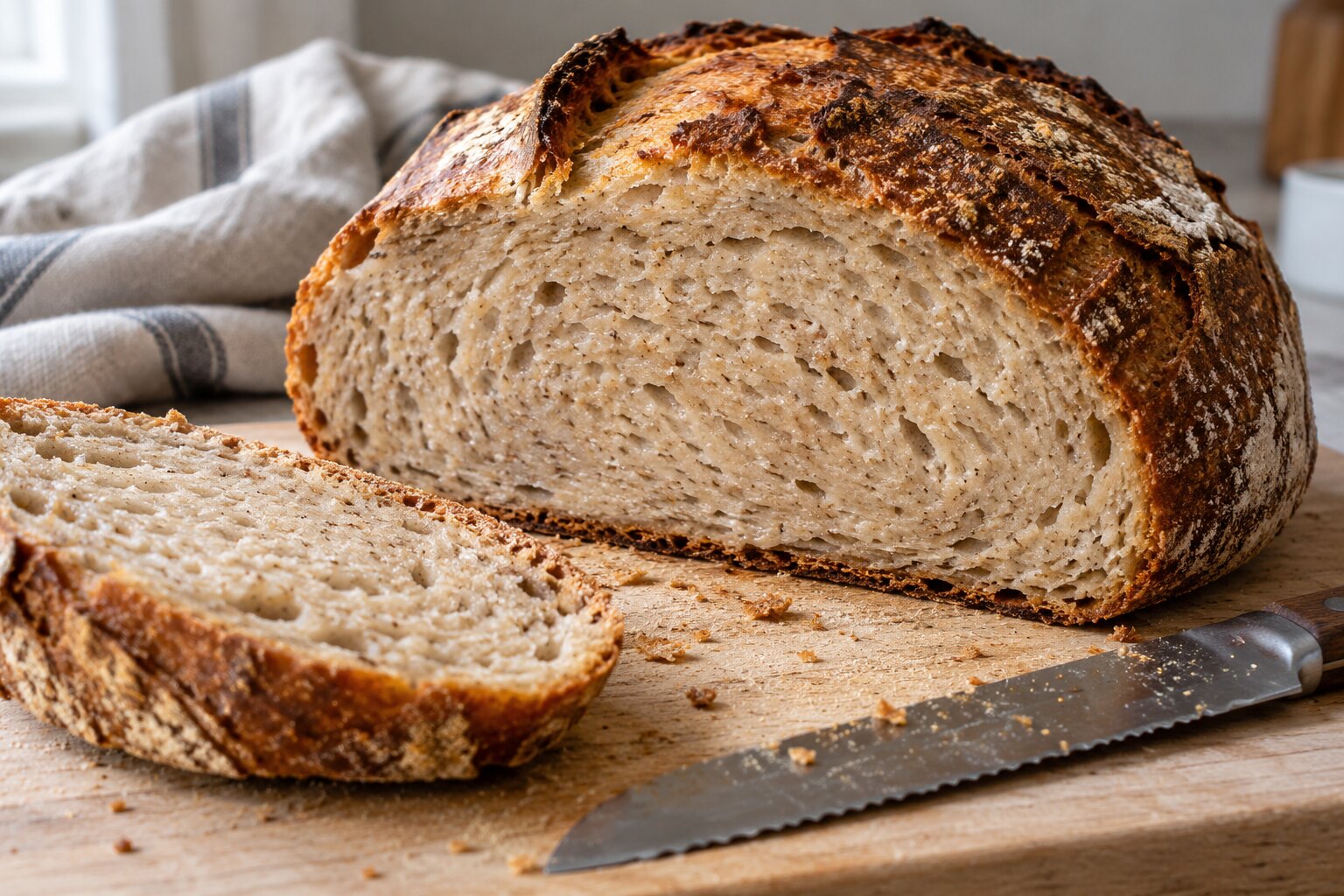
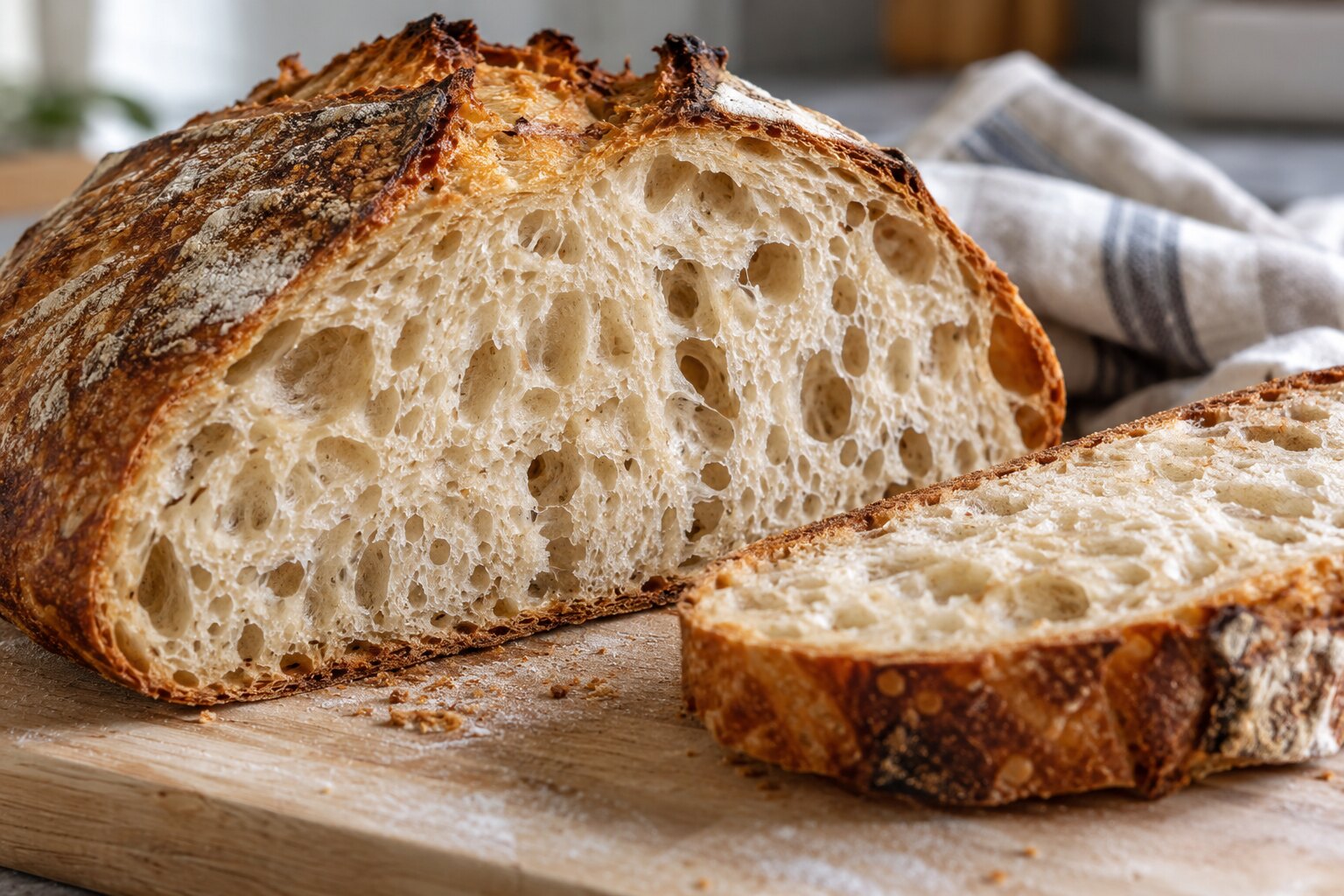
A well-baked sourdough crumb is set, tender, and slightly moist, with holes that match the flour, hydration, and fermentation. It does not need enormous tunnels to be successful; a sticky or compressed centre is a more useful warning sign.
There is no single perfect crumb
Sourdough crumb depends on the flour, hydration, starter strength, fermentation, shaping, and the kind of bread you want to make. A rustic country loaf may have larger irregular holes, while sandwich bread should have a finer, even crumb that holds fillings. Bigger holes are not automatically better.
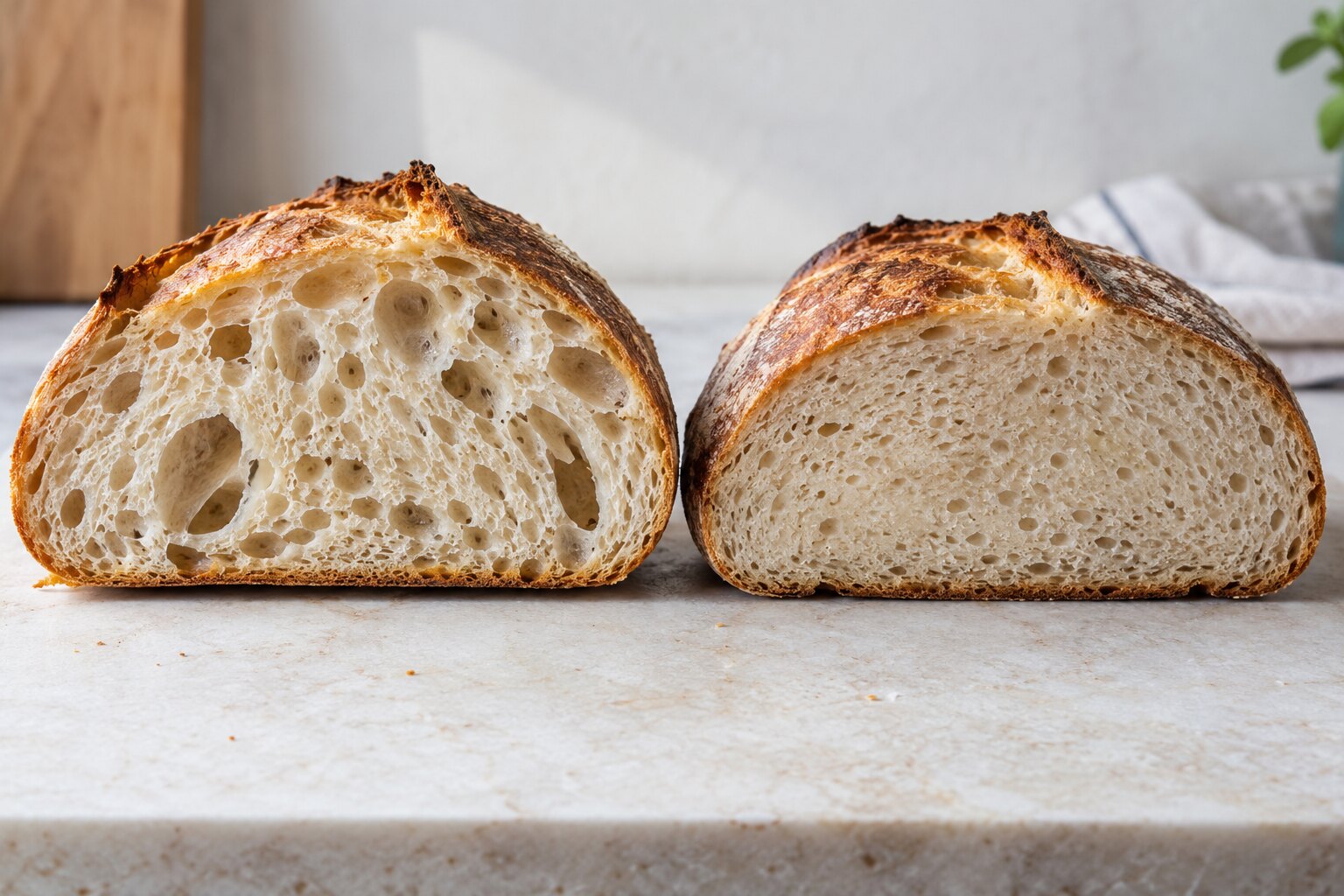
What a well-baked crumb can show
- The interior is fully set rather than wet or paste-like.
- The holes are distributed in a way that matches the style of bread.
- The crumb feels tender and elastic instead of crumbling or sticking to the knife.
- The colour is even, with no raw-looking band running through the centre.
- The bottom and edges are baked enough to support the slice.
Common crumb clues
| What you see | What it may suggest | First thing to check |
|---|---|---|
| Even, set crumb with small or medium holes | The loaf may be well fermented and baked for its style. | Keep notes so you can repeat the formula. |
| Very tight crumb throughout | Weak starter, short fermentation, low hydration, or too much degassing. | Check starter activity and bulk fermentation. |
| Sticky or gummy centre | Underbaking, cutting too early, or incomplete fermentation. | Cool fully, then review bake time and fermentation. |
| Large tunnels near the top with dense areas below | Uneven fermentation or shaping that trapped large pockets. | Strengthen the dough and shape more evenly. |
| Flat crumb with a collapsed structure | Overproofing, weak dough, or too much water for the flour. | Compare the dough with the overproofed and hydration guides. |
Wait before you slice
Bread continues to set as it cools. Cutting a large loaf while it is hot can compress the crumb and make it look gummy even when the bake is close. Let the loaf cool on a rack until the centre is no longer hot, then use a serrated knife and a gentle sawing motion.
How fermentation changes the inside
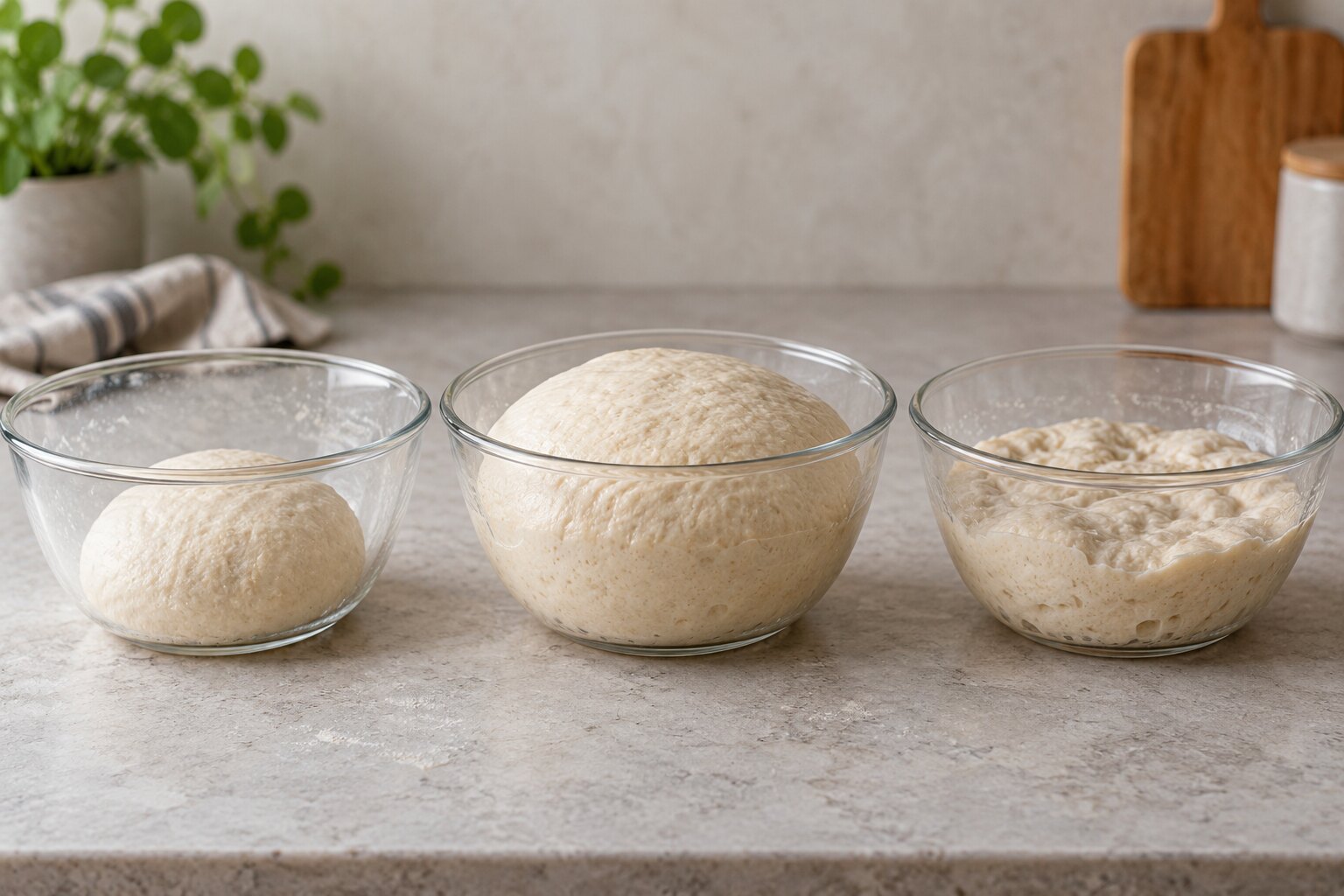
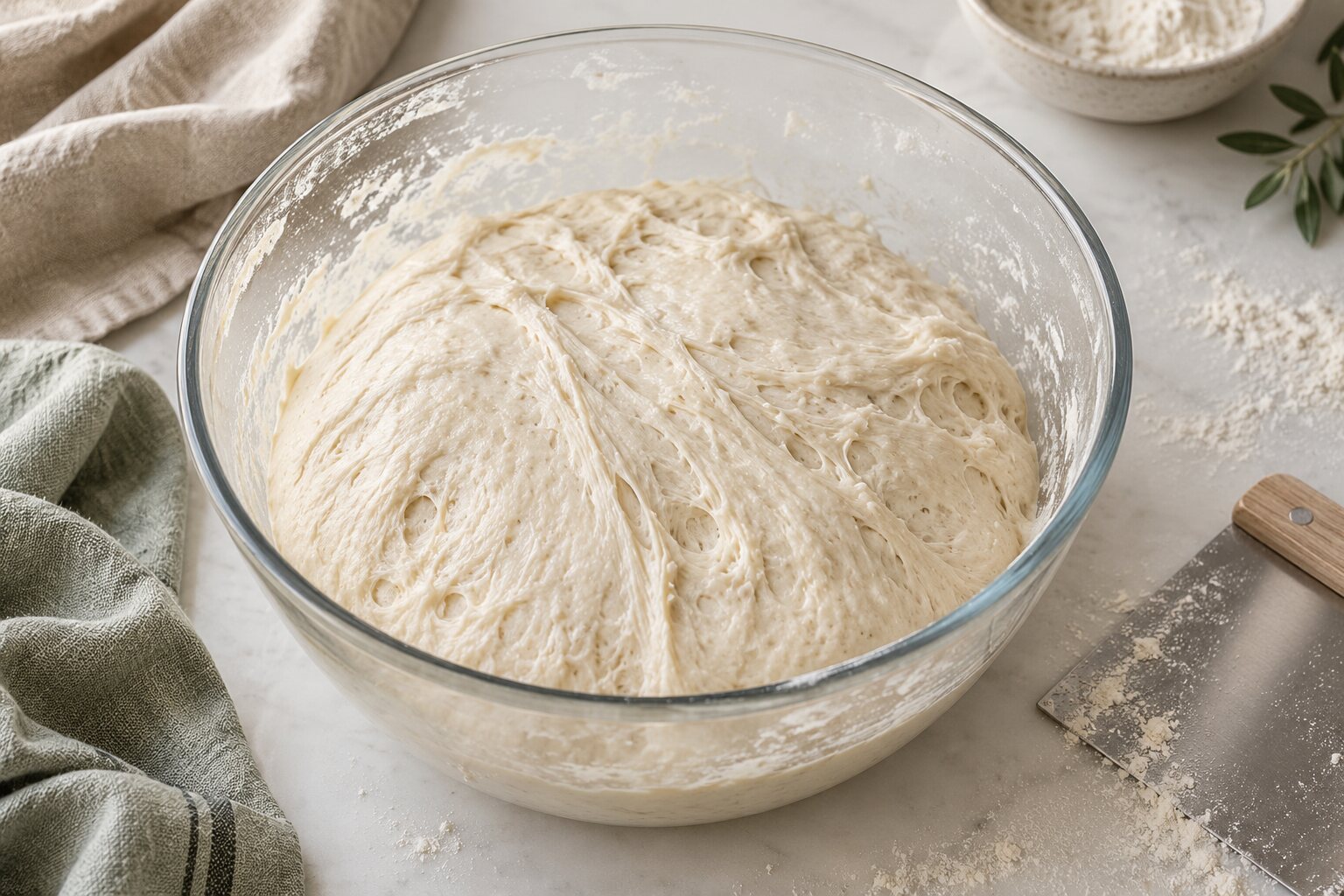
Under-fermented dough often has a heavy or tight interior because it did not build enough gas before baking. Over-fermented dough may spread and lose the structure that holds gas. Read the crumb alongside the loaf shape, oven spring, dough temperature, and proofing time instead of diagnosing from one hole.
If the crumb is dense and gummy, continue with Why Is My Sourdough Dense and Gummy?. For a timing comparison, use Is My Sourdough Overproofed or Underproofed?.
What about sandwich bread?
A sourdough sandwich loaf should usually have a finer, softer crumb than a high-hydration artisan boule. It needs enough structure to slice cleanly and hold a filling. Judge it by tenderness, evenness, and whether the centre is fully baked—not by whether it has dramatic open holes.
The best way to learn from your crumb
- 01Take a photo after the loaf has cooled completely.
- 02Write down the starter rise, dough temperature, bulk time, proof time, and bake time.
- 03Describe the crumb as set, moist, sticky, tight, airy, or uneven.
- 04Change one part of the process on the next bake.
- 05Compare the result with the style of bread you intended to make.